
Stop Networking. Start Showing Up.
A stack of spreadsheets, an Apple acquisition, and the brutal cost of staying silent.
San Francisco, 2011.
I walked into that Health 2.0 meetup with business cards, a polished resume, and a plan to work the room. I was one of the first ten people through the door.
I never made it inside.
I spent the entire evening huddled over printouts in the foyer with a guy tracking his depression with spreadsheets. Two weeks later, I joined his startup as Co-founder and CTO. Eighteen months later, Apple acquired Gliimpse.
The Setup: The “Everything Right” Failure
My first startup had cratered. I had spent the final months zeroing out my own pay just to keep my engineers' checks from bouncing. My original salary had barely covered rent; now, I had nothing. I needed a home run, fast.
I ran the standard job-hunt playbook. Resume updated by 8:00 AM. Coffee with a director at 9:00 AM. Phone screen at 10:00 AM. By 1:30 PM on that first day, I had my first concrete job offer in hand.
But I wanted a home run. So I stayed out from 7:00 AM to 11:00 PM every day. Meetups. Coffee chats. Business cards ready. The Health 2.0 meetup was strategic. I was prepared, focused, and early. What I didn't know was that I was about to do the opposite of everything I planned.
The Foyer Conversation: Two Levels Deep
I reached for the door handle to the main event. A friendly guy named Jeremy stopped me.
“I have chronic depression,” he said. “Someone over there said you like health, AI, and data. Look at this.”
The “someone” was a guy I'd met earlier that week. I'd helped him debug an AI architecture problem and connected him with a potential investor. No invoice. No strings. Just genuine help. He paid me back by sending me Jeremy.
Jeremy filled a table with printouts—data from his laptop and iPad. He was tracking mental health questionnaires hourly. Logging every meal. My previous startup had aimed to digitize exactly what he was doing manually.
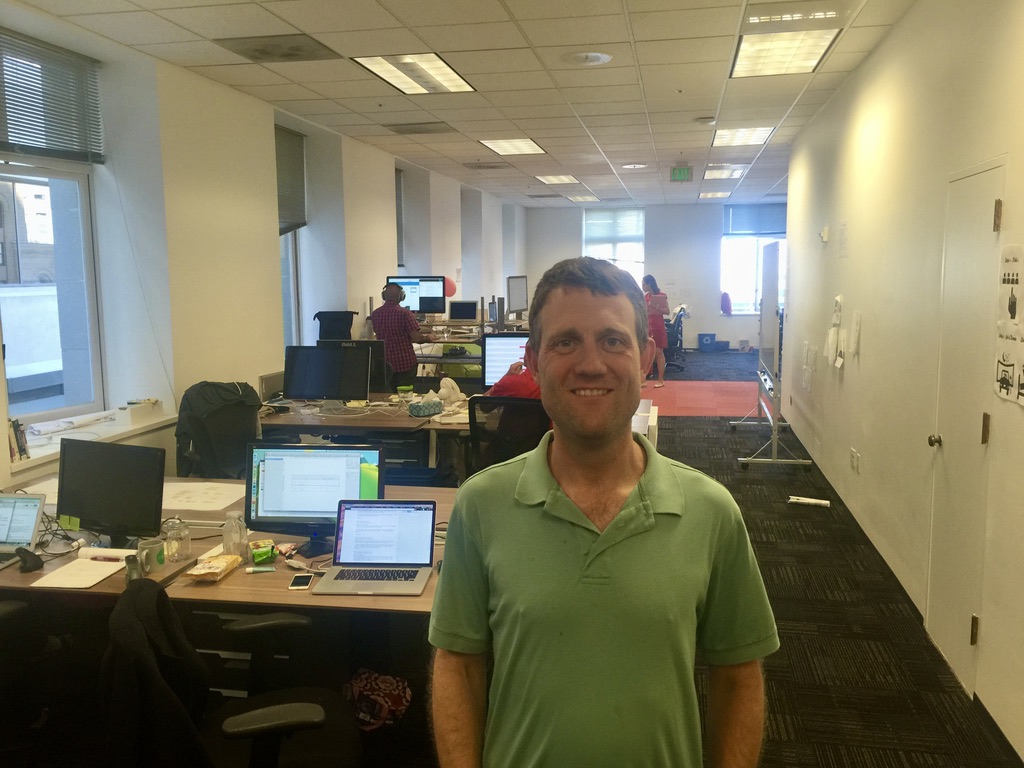
Jeremy in his element. This was from one of our “fake” interviews—I’d apply for jobs just to have an excuse to spend three hours in a room with him.
We spent three hours pouring over patterns. When I looked up, the event had ended. Everyone had left. On the way out, I mentioned I was looking for a job.
The next day, Anil called me.
They weren't looking for more hands; the team was supposedly full. But Jeremy had spent the morning talking about my technical skills and my passion for the space. He wasn't even “advocating”—he was just sharing what happened in the foyer. It piqued Anil's curiosity enough that he had to call.
I joined Gliimpse as Co-founder and CTO shortly after. Apple acquired Gliimpse not long after that.
“When everyone's extracting, genuine help becomes the scarcest resource in the room.”
The Inverse Networking Principle
Everyone at networking events is asking for something. They are extracting. But when you are the only person offering help in a room full of people asking for it, you become memorable. Trustworthy. Different.
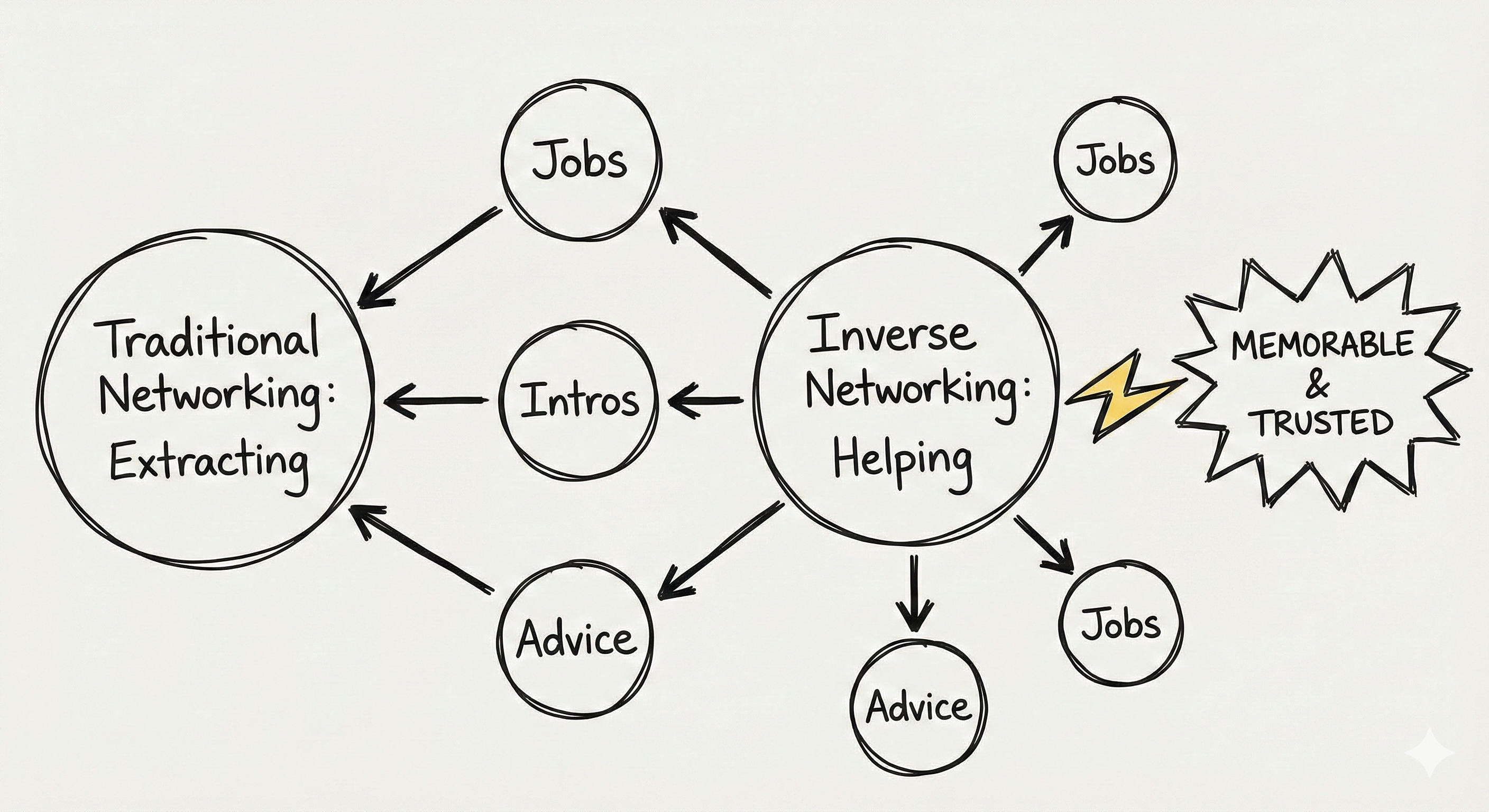
The shift is subtle: Go to events where you actually want to learn—or where you know you can help. If you aren't interested in the topic, you can't authentically provide value. When someone shares a problem, don't networking-pivot back to your agenda. Follow the curiosity three levels deeper than anyone else would.
Offer specific help, not vague platitudes. “Let me know if I can help” is garbage. “I had a very similar problem last week with my code. Want me to look?” is value.
What Jeremy Taught Me About Showing Up
I learned later who Jeremy actually was: Valedictorian, Stanford PhD, holder of multiple heart pacemaker patents. He was a brilliant mind until black mold in a sub-terrain apartment triggered a permanent chemical reaction in his brain.
But what I remember most is that Jeremy was the guy who always showed up.
He was there for every beer at the German bar. Every meetup I organized.
Then his doctor adjusted his medication: preparation for the family he and his wife were building. Jeremy wouldn't change it back until after the twins were born. Their health came first.
About a year before those twins arrived, I saw the first cracks. I tried explaining a technical concept to him. It took him hours to understand. The next day, it was gone. We had to start from scratch.
He couldn't function as a co-founder of an ambitious startup anymore. We helped him find a mid-level engineering position at a larger health-tech company—a role he could manage.
After his twins were born, he took the first train home every night. No exceptions. No one came before his family.
During COVID, we didn't talk much. Then I saw the news.
I knew the statistics of what a simple daily—or even weekly—“u ok?” text can do for someone with depression. I knew the math, but I ignored the logistics. I didn't check in. Not the way Jeremy had always shown up for everyone else.
The Question
Everyone else at that Health 2.0 meetup worked the room. I'm sure some of them got jobs. But I got Jeremy. And through Jeremy, I got Anil.
Through Gliimpse, we built the technical foundation for something that now quietly manages the health of hundreds of millions of people every day. It's infrastructure that carries the weight of a billion heartbeats.
More importantly, I learned how to show up. Not just for founders, but for my son. The question isn't “who do you know.” It's “who have you shown up for?”
Go to your next industry event looking to help. Not with a motive. Just to help. See what happens.
RIP my friend. I'm trying to do better.
Published January 2026