The Three Words That Fix Startup Time Warp
Here's a conversation I've had approximately 47 times:
Founder, Monday 9am: "We need that enterprise dashboard by Friday for the Acme demo."
Me: "The one you mentioned last week?"
Founder: "No, the AI-powered one with the predictive analytics."
Me: "That didn't exist last week."
Founder: "Yeah but Sarah from Sequoia said it would be transformative and—"
You know how this ends.
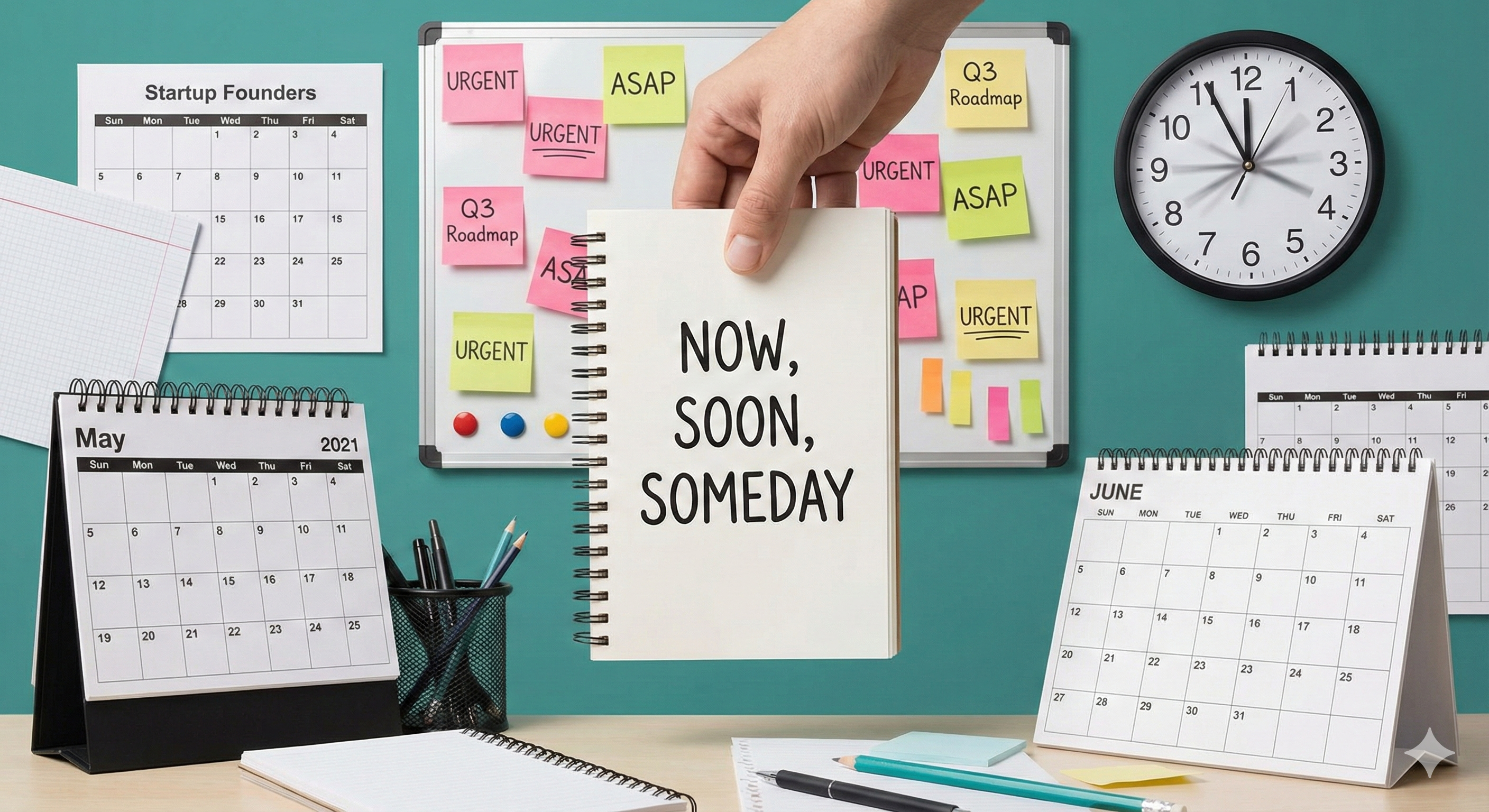
Startup founders exist in a temporal paradox. A casual coffee turns into three "must-have" features. An investor meeting spawns a product pivot. Yesterday's roadmap is today's archaeological artifact. And somehow, everything is both "critical" and due "ASAP."
I got tired of playing timeline whack-a-mole. So I stopped asking founders for dates.
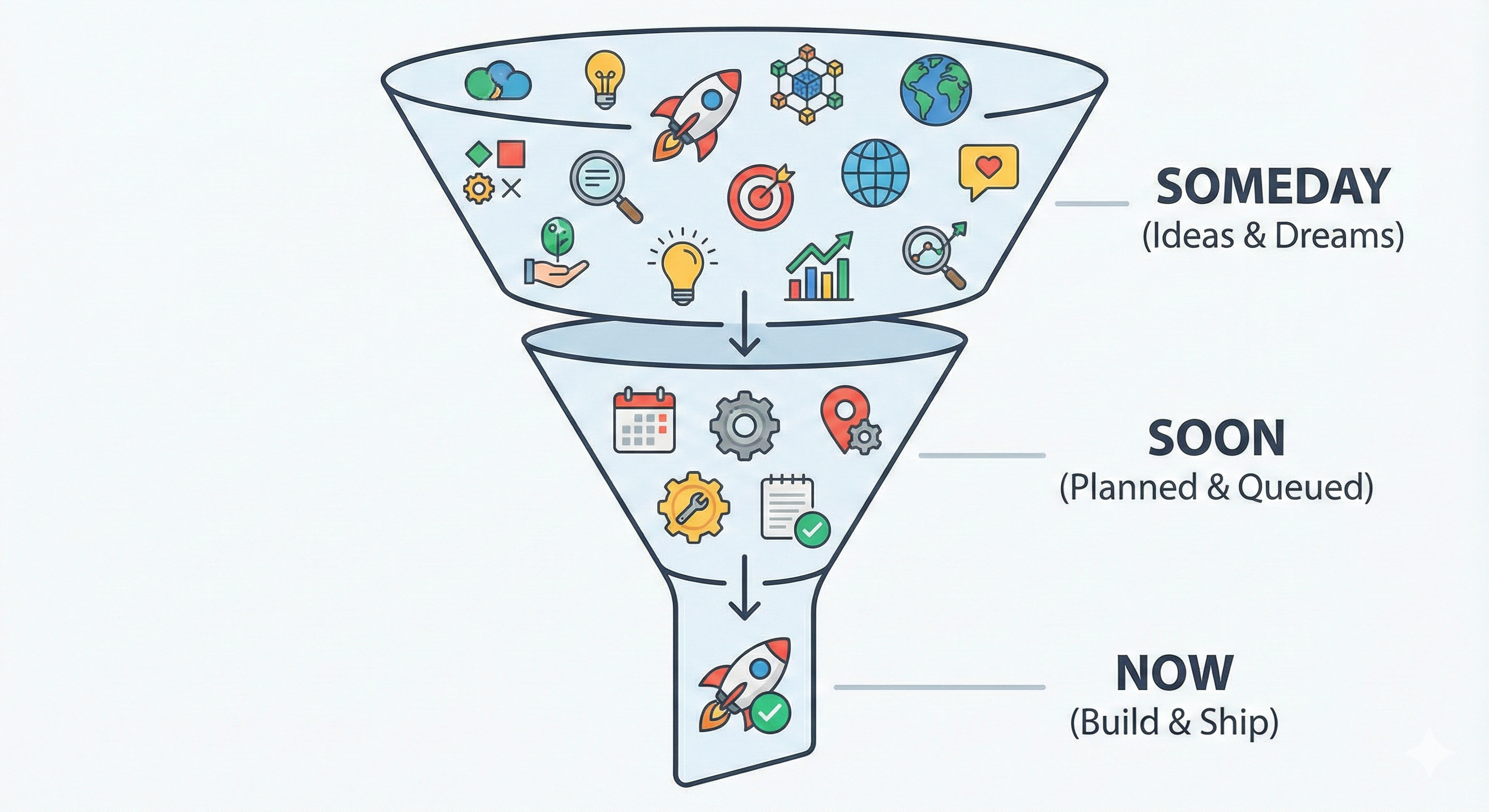
Instead, I taught them three words: Now. Soon. Someday.
That's it. No quarters. No sprints. No Gantt charts that nobody looks at after the second pivot.
Now means build it, ship it, or we're dead. Drop what you're doing.
Soon means it's real, it's coming, put it in the queue.
Someday means write it down, we'll get there, or we won't.
You know how good UX designers use sketchy wireframes instead of pixel-perfect mockups? Because the moment you show someone polished designs, they debate button colors instead of whether the flow makes sense. Same principle here. The moment you give a founder a precise date, they bikeshed the timeline instead of thinking about priority. "Soon" forces the real question: is this actually important?
Why Three Words Beat Three Hundred Meetings
It forces honesty. When everything can't be "Now," founders actually have to think about what matters. I've watched founders pause mid-sentence, realize they're about to call something "Now" for the third time that day, and recalibrate. That pause is worth a thousand priority matrices.
It scales with your company. At (pre-)seed-stage startups, "Now" means today, "Soon" means next week, and "Someday" means next month. At the trillion-dollar investment firm I helped transform, "Now" meant this quarter, "Soon" meant next year, and "Someday" was measured in decades. Same words. Completely different timescales. The framework adapts; you don't need a new system every six months.
It survives pivots. Detailed roadmaps are beautiful lies. They assume a static world. The moment you sign that unexpected enterprise customer, or your competitor launches that feature, or your lead engineer quits, those carefully planned Q2 initiatives become fiction. But "Soon" items are still "Soon" - they just might get bumped by new "Now" items. The relative priority holds even when the timeline explodes.
It eliminates language barriers. I've used this with founders whose first language is Mandarin, German, Hindi, Hebrew. Three simple words. No mistranslation. No cultural differences in how you interpret "urgent" versus "high priority" versus "time-sensitive." Now is now in every language.
It protects your team from whiplash.Engineers aren't stupid. They know when they're being jerked around. When priorities change every standup, when last week's critical project is suddenly abandoned, when "drop everything" becomes the daily drumbeat - that's how you lose your best people. Now/Soon/Someday gives the chaos structure. Your team can handle "Hey, that Soon item just became Now because we landed the Adobe deal" - they can't handle "Everything is always critical and we never finish anything."
It reveals founder psychology. Pay attention to the ratio. A founder who labels everything "Now"? They're panicking, or they don't trust you, or they haven't actually thought about priority. A founder who has nothing in "Now" and everything in "Someday"? They're either paralyzed or not actually committed. A healthy founder has a few items in Now, a reasonable pipeline in Soon, and a long tail of Someday items they're excited about but won't die without.
It makes standups actually useful. "Did you finish the Now items? What's blocking them? Cool, here's what just moved from Soon to Now." Done. No 45-minute philosophical debates about whether we should move the API refactor from Q3 to Q2. No project manager asking if we're "still on track for the timeline we discussed in the January planning session." Just what's happening today, this week, and eventually.
Write Down The Crazy Stuff
I can hear the objection already: "Jan, why should I write down ideas we'll never build? Isn't that just lying to the founder?"
No. It's the opposite.
I learned this from a parenting book of all places - How to Talk So Kids Will Listen & Listen So Kids Will Talk by Adele Faber and Elaine Mazlish. I read it 12 years before my son was born, and it turns out founders, excitable early-career coworkers, and toddlers have something in common: they want to be heard. And writing their thoughts down emphasizes that you do hear them and take their ideas seriously.
When a founder pitches you their blockchain-AI-quantum-NFT idea at 11am on a Thursday, they're not (usually) demanding you build it tomorrow. They're asking: "Do you see what I see? Is this interesting? Am I crazy?"
Writing it down as "Someday" answers all three: Yes, yes, and no.
It validates them. It acknowledges the idea has merit, even if the timing is wrong or the resources aren't there or the market isn't ready. That matters more than you think - especially for founders dealing with imposter syndrome, investor pressure, or the grinding anxiety that they should be further ahead by now.
I've filled countless Google Sheets and Notion pages with "Someday" ideas. Multi-language support for a product with 47 users. Enterprise SSO before we had a single enterprise customer. An API marketplace when we barely had an API.
You know how many times I had to defend not building these? Almost never. The act of writing them down diffused the urgency. The founder felt heard, moved on to the next fire, and six months later we'd laugh about the quantum-NFT idea together.
But in the moment? They were happy.
And that's half the job.

The Definitions Don't Matter - The Discipline Does
The beauty isn't in the definitions - those shift with every company, every stage, every market condition.
The beauty is in the clarity.
When a founder says "Soon," I know two things immediately: it's important enough to plan for, but not important enough to derail current work. No need to debate whether it's a Q2 or Q3 priority - that distinction evaporates the moment the next customer call happens anyway.
And here's what actually happens after you use this for a few months: founders start self-correcting. They catch themselves. "Actually, you know what, that's not Now, that's Soon." They've internalized the discipline. They're thinking about priority differently.
That's when you know it's working.
Of course, knowing when to build something is only part of the equation. And translating founder enthusiasm into steady team execution? That's a whole different skill set.
But start here. Three words. No more time-continuum whiplash. No more "I thought you said this was urgent three weeks ago" conversations.
Just Now, Soon, or Someday.
Choose one. Ship accordingly.
Publish December 2025