
Hands Write Code. Owners Solve Problems.
Monday morning. New hire arrives. Laptop ready. Expecting GitHub access and a Jira ticket.
I tell them to close the laptop.
No code. No product demo. No bug reports. Not for days.
Most startup founders are confused when I explain this. They hired "hands" to type. They need features shipped yesterday. Why would I waste a whole week on "orientation"?
Because I don't hire hands. I hire owners.
And you can't own what you don't understand at a molecular level.
The Pattern I Keep Seeing
I've debugged this failure dozens of times. Senior engineer quits at month three. "Codebase is a mess. No one listens." Day one they got GitHub access, a Jira ticket, and a pairing buddy. Customer calls? Zero.
Feature factory model: Treat engineers as code-producing units. Feed them tickets. Extract features.
Then act surprised when they quit. When they stop caring. When nobody loves what you built—not customers, not your own team.
Twenty-some years ago, I was that confused new hire on a self-driving car project. Day one, they handed me sensor fusion code. Four weeks "contributing" before I understood we were solving the wrong problem. Lead scientist optimized for elegance. Real-world use needed simple reliability. A whole month wasted because no one explained the Why.
Now I run things differently.
The Three-Layer Protocol
When someone joins my team, they don't see code for a week. Instead: The Why. The How. The What.
Not onboarding. Ownership building.
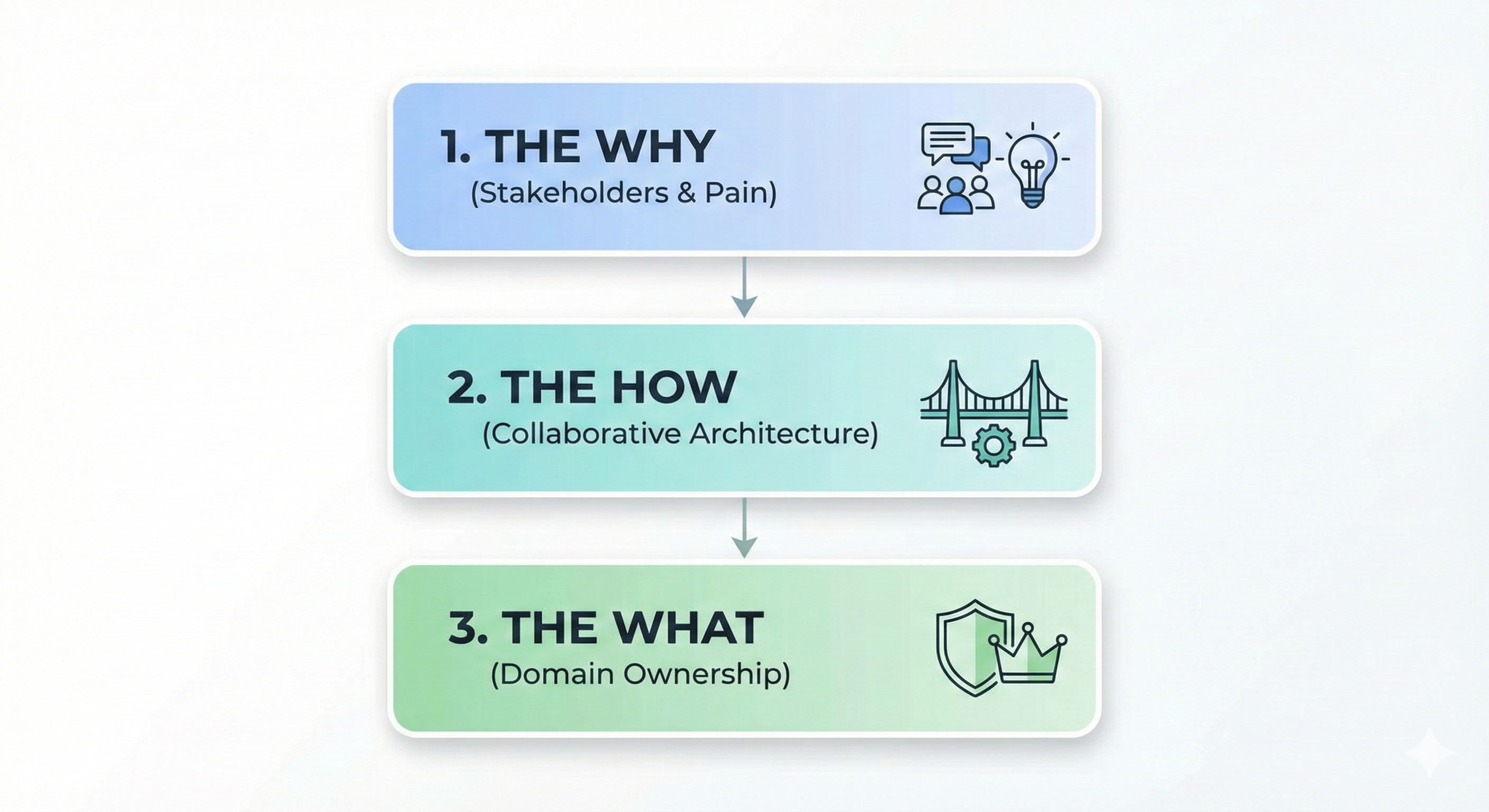
Layer 1: The Why (Days 1-5)
This isn't just onboarding philosophy—it's how I lead everything. Every technical decision. Every architectural choice. Every feature. If you can't tie it to purpose, you can't defend it.
"By Friday, the engineer can explain who loses money if we don't exist and what keeps our users awake at 2 AM."
First week is immersion in the Problem Space.
If geography allows, we share meals with the founder. Not Zoom calls—food, drinks, conversations where people say what they think after the second beer. We sit in on customer calls. Talk to board members. Listen to support tickets being filed.
Recent client engagement: new architect joins during fundraising crunch. CEO wanted him coding immediately—"we need to show investors progress."
I pushed back hard.
Put him in the room for three investor pitches and two customer escalations. By day four, he understood technical debt wasn't laziness—it was survival. Previous team made the only choices that kept the company alive long enough to raise this round.
His approach changed. Instead of proposing a six-month rewrite, he identified three targeted fixes that addressed what mattered to customers.
Here's what most companies miss: Once someone sees your product—the codebase, the architecture, the UI, the UX—you lose their fresh perspective forever. You get one shot at unbiased insights. Show them the Why first, ask how they'd solve it, then show them your approach. That sequence matters. Do it backwards and you've just hired someone to make small iterative improvements in potentially the wrong direction.
Skip this? Engineers optimize for the wrong thing. Beautiful code that doesn't solve the burning problem. Frustration. Tickets that don't add up. Attrition.
Layer 2: The How (Week 2)
Map technical architecture to the humans building it.
Most CTOs dictate the How. "We're using microservices." "Everything in Kubernetes." "React on frontend." Decisions made in isolation, handed down like stone tablets.
My teams? Collaborative.
Before we architect, we map the talent:
Personal skill roadmap? Want to level up in a specific technology and the project supports it? We architect for that. Not running a bootcamp, but not wasting the opportunity to align company needs with your growth.
Scar tissue? Every experienced engineer has seen something fail catastrophically. Gold. "I watched Postgres fall over at 10K writes/second" beats any blog post.
Genuine curiosity? Leading indicator of ownership. Someone lights up talking about event streaming and we need messaging infrastructure? Signal.
At the investment firm, an accountant wanted to master Python. Critical data pipeline needed rebuilding. Most tech leaders would say "no time for learning" or "leave it to engineers." Instead, we architected in Python, made him read a book, paired with him for a week, let him own it. Three months later, that pipeline saved more than his annual salary while reducing risk. He became the Python expert for the entire accountant community. Win-win.
"Treating architecture as purely technical misses that the How is where you build ownership or create resentment."
Layer 3: The What (Week 3+)
By week three, every engineer owns a domain. Their baby. Not responsible for tickets—responsible for health, scaling, eventually hiring for that domain.
Where "confused hire" becomes "high-functioning owner."
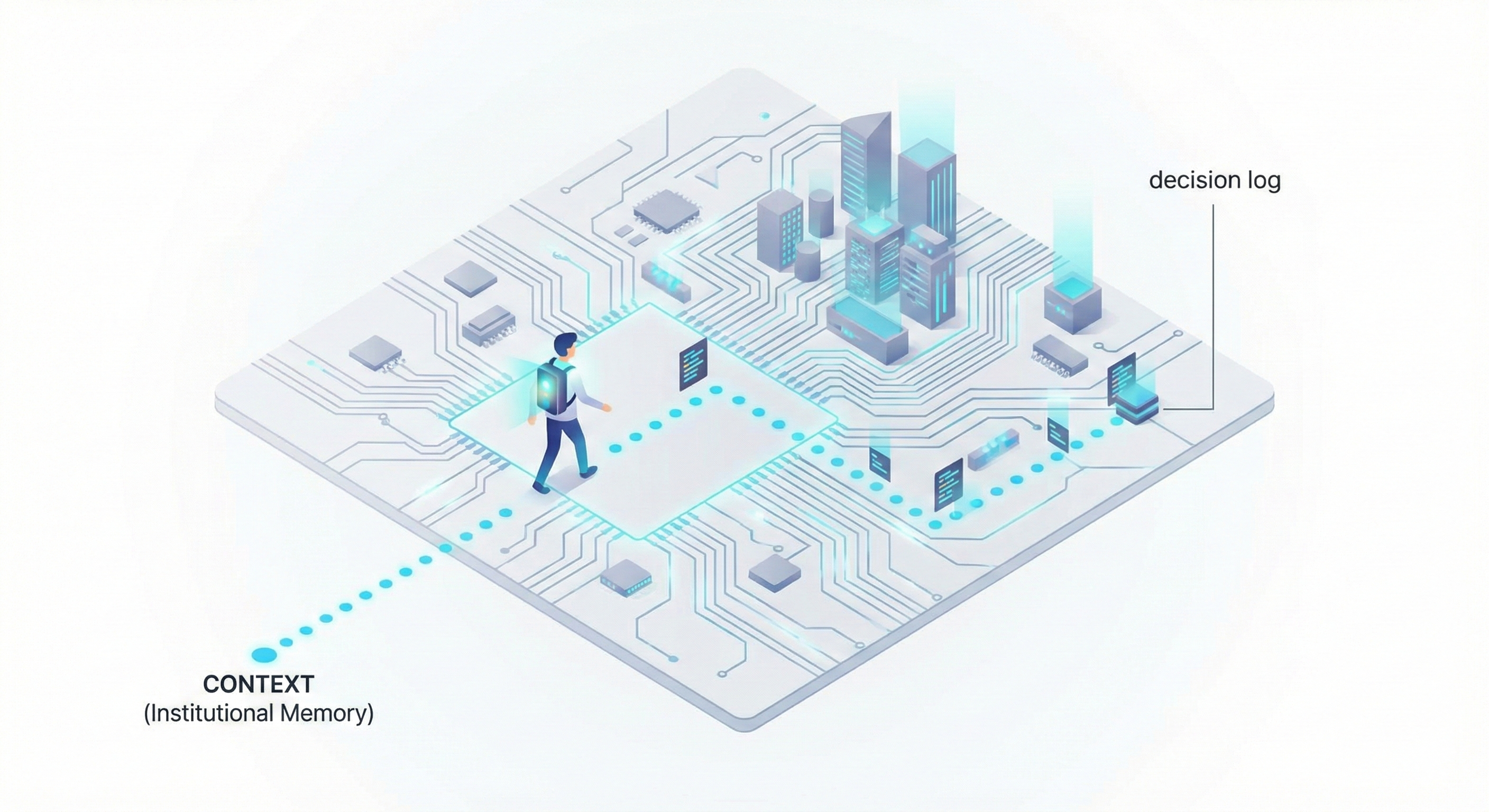
Autonomy without documentation is chaos. We use a Decision Log.
"Total control over your domain. Every major decision gets logged. Not for approval—for institutional memory."
Not micromanagement. Trail of breadcrumbs that lets us scale without constant sync meetings. Someone asks "why Postgres over Mongo for the ledger?" They read the log. See the constraints at decision time. Don't schedule a meeting.
Format:
Decision: [What we chose]
Context: [Why it mattered]
Constraints: [What limited options]
Trade-offs: [What we gave up]
Date: [When we decided]
Prevents the failure where an engineer makes a reasonable decision, leaves six months later, next person reverses it without context. Waste of time. Waste of energy. Preventable.
Ownership doesn't mean isolation. You own the domain, but you don't build in a vacuum. Get feedback. Ask for reviews. Some reviews—security, architecture, data integrity—are mandatory. Ownership means you're accountable for the outcome and responsible for gathering the input you need to make it right.
And when anyone has a question about that domain? Including me? They come to you. That's ownership.
What This Produces
By end of week two, that engineer opens their IDE and doesn't need permission to act. They know the customer's voice. They helped design the map. They're ready to defend their domain.
Not slower than the feature factory. Faster. Because you spend zero time on:
- Rework from solving the wrong problem
- Meetings to debate decisions already made
- Explaining context for the fortieth time
- Damage control when someone pushes technically excellent but strategically stupid changes
When This Doesn't Apply
Never.
I've done this with teams of two. I've done this with teams of fifty. The protocol scales.
Best startup team I ever built? Hired five engineers on day zero right after funding closed. Spent two full weeks on Why, How, What before anyone touched code. CEO and board were nervous. "You're burning cash on orientation?"
Six months later, that team shipped more than any feature factory I'd seen. Zero rework. Zero "why did we build it this way?" meetings. Zero attrition.
The mistake isn't taking two weeks when you think you only have two days. The mistake is skipping Why and handing someone a Jira ticket.
Compress the timeline if you must. Never reverse the order.
Your Move
Hands need tickets. Owners need context.
Hands need supervision. Owners need autonomy.
Hands need deadlines. Owners need purpose.
"You create this separation in the first five days."
Your best engineer is three weeks from quitting. Not because the code is bad. Not because the pay is low. Because they've been there six months and still can't explain who you're building for or why it matters.
They write code. They don't solve problems. They're a hand pretending to be an owner.
You did this on day one.
The Monday Test
Ask your most senior engineers:
- "Why did our biggest customer choose us?"
- "What problem keeps our users awake?"
- "What would happen if we disappeared tomorrow?"
Can't answer?
Close their laptop. Start over.
This is how I start every fractional CTO engagement. Before I look at a single line of code or architecture diagram. If your senior people can't answer these questions, you don't have an engineering problem. You have an ownership problem.
Published January 2026